
Powered By



Your fingernails can tell you a lot about your overall health, including your kidney health. In the early stages of immunoglobulin A (IgA) nephropathy, you might notice subtle nail changes. These may be linked to side effects of medication or early signs of reduced renal (kidney) function. As the condition progresses, more noticeable or severe nail changes may appear.
Here’s a breakdown of the types of nail changes you might see and what they can mean.
Your nails are the hard coverings at the ends of your fingers and toes. They’re made of skin cells that produce keratin, a protein that gives nails their strength and hardness.
Sign up to view the results!
 Continue with Facebook
Continue with Email
Continue with Facebook
Continue with Email
The hard, curved part we usually think of as the nail is called the nail plate. It sits on top of the nail bed, the skin underneath. The lunula is the pale, half-moon-shaped area at the base of your nail, where new nail cells are made and growth happens. It may be more or less visible depending on your skin tone.
Your nails grow slowly, about one-tenth of an inch every month. It can take three to six months for a fingernail to fully grow out. Toenails grow even more slowly, so replacing one can take even longer.
Several factors can affect your nails — including skin conditions, vitamin or mineral deficiencies, and chronic (long-term) illnesses like kidney disease.
IgAN can change the look and feel of your nails in several ways.
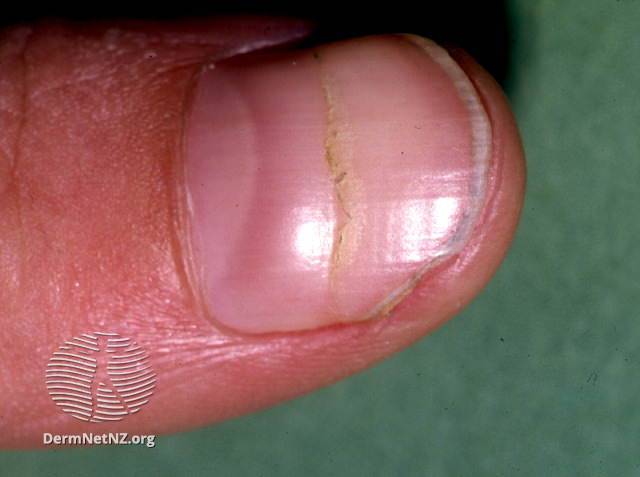
Some people with IgAN develop abnormal ridges in their nails. A ridge can run horizontally or vertically in your nail.
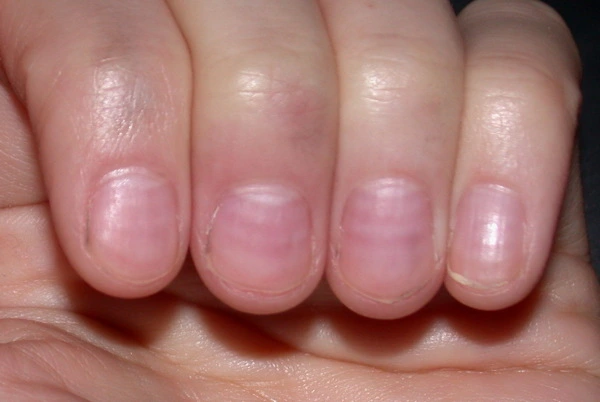
Beau’s lines are a possible type of nail ridge seen in kidney diseases like IgAN. These are horizontal dents that mean nail growth temporarily stopped. Growth interruption can happen from an illness (such as acute kidney failure) or an infection.
Spoon-shaped nails — also known as koilonychia — may develop with IgAN. People with koilonychia have soft nails that grow in a dented spoon shape rather than straight.
The most common cause of koilonychia is iron-deficiency anemia. Anemia affects 1 in 7 people with chronic kidney disease.
You may notice that your nails are thinner or more brittle than usual. This may affect people with IgAN due to medication side effects or insufficient nutrient intake.
One member of myIgANteam shared, “Most of my life my nails have been very strong, up until a year ago. They now split, crack, and I can’t get them to grow.”

Some people with IgA nephropathy may experience fungal nail infections called onychomycosis. This can be a potential side effect of immunosuppression. That means your ability to fight off diseases and infections is lower than average.
If your kidneys are severely damaged from IgAN, you may be more likely to notice additional nail changes. This can happen if the disease progresses to advanced chronic kidney disease (CKD), a long-term condition in which the kidneys lose their ability to filter waste effectively.
These nail changes are not caused directly by IgAN but, rather, by the effects of:
Some people with kidney disease may notice that their nails become pale or white, a condition known as leukonychia. Leukonychia refers to white discoloration of the nail plate and is one of the most common nail changes in people who have received a kidney transplant.
Three types of leukonychia may be associated with kidney disease:
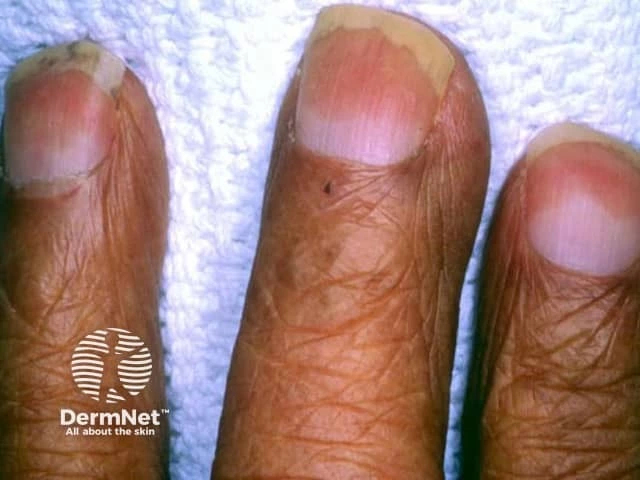
If you have half-and-half nails — also called Lindsay’s nails — the bottom halves of them (closest to your knuckles) appear white. The top halves (closest to your fingertips) are discolored pink, red, or brown. This nail change affects about a third of people with kidney failure on dialysis.
When the nail plate becomes separated from the nail bed, it looks like opaque white sections on the nail. This condition, called onycholysis, is seen in kidney disease and with other issues, like nail injuries, skin conditions, or infections.
According to some research, onycholysis may affect around 71 percent of people with renal failure.
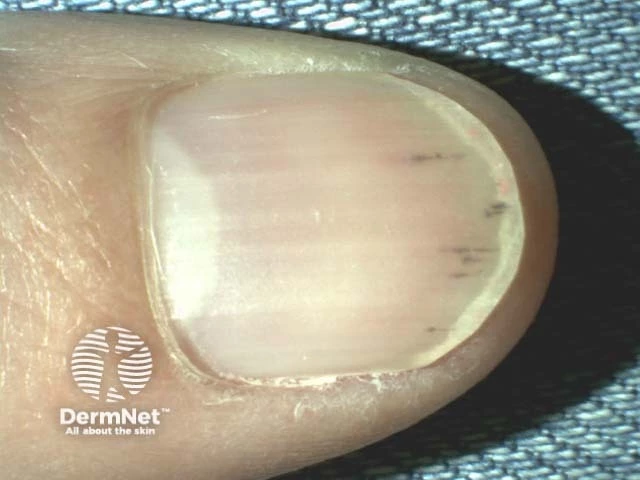
A splinter hemorrhage looks like a splinter is stuck under your nail. Splinter hemorrhages can appear as red or purple lines under your nails. Some research suggests that 58 percent of people with renal failure have splinter hemorrhages.
You may develop a splinter hemorrhage if the capillaries (small blood vessels) under your nail become fragile, which is common in kidney disease. Splinter hemorrhages are most often caused by trauma, but they can also be caused by other conditions that affect blood vessels.
Your nail health can reveal important clues to the health of your body as a whole. Nail abnormalities can occur even if your IgAN is mild and well treated. Issues like anemia, malnutrition, medical side effects, and fungal infections can be a concern for people with IgAN. Discussing nail symptoms can help pinpoint any underlying problems that should be addressed.
Talk to your healthcare team about a treatment plan that includes proper nail care and nutrition.
Get updates directly to your inbox.


What can cause pinkinsh color spits just aove the lulunea if your nail


 Continue with Facebook
Continue with Email
Continue with Facebook
Continue with Email
Continue with Facebook
Continue with Email
Continue with Facebook
Continue with Email
Become a member to get even more





 Join
Join





 Your Privacy Choices

This is a member-feature!
Sign up for free to view article comments.
Most of my life my nails have been very strong -- up until a year ago. They now split, crack and I can't get them to grow. I have fourth stage kidney disease and have been reading about how kidney… read more
We'd love to hear from you! Please share your name and email to post and read comments.
You'll also get the latest articles directly to your inbox.